Architecture Overview
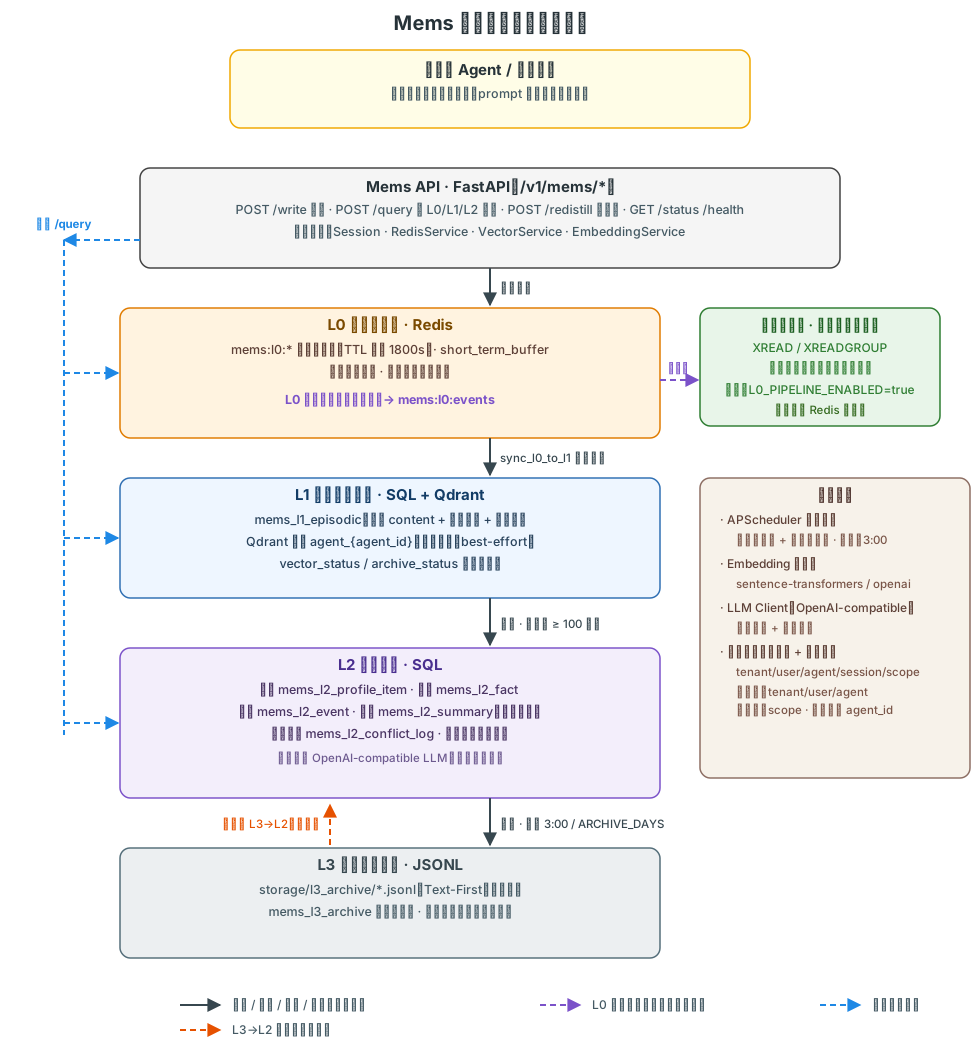
L0 hot cache → L1 episodic ledger → L2 distilled knowledge → L3 cold archive, plus a default-off L0 output stream for consumers that bring their own code.
Four-Layer Design
| Layer | Responsibility | Storage | Key Entities |
|---|---|---|---|
L0 | hot recent-memory cache, fast recall window; never manages runtime state | Redis | mems:l0:* snapshots (TTL), short_term_buffer, optional stream mems:l0:events |
L1 | episodic memory ledger: online source of truth, replay and audit | SQL + Qdrant | mems_l1_episodic; Qdrant collection agent_{agent_id} (derived vector replica) |
L2 | distilled long-term knowledge with lineage and versioning | SQL (+ vector index for summaries) | mems_l2_profile_item, mems_l2_fact, mems_l2_event, mems_l2_summary, mems_l2_conflict_log |
L3 | century-scale cold archive, format-portable | JSONL files | storage/l3_archive/*.jsonl, mems_l3_archive batch metadata |
Memory Taxonomy: A Cognitive Science View
Mems borrows the classic cognitive-science taxonomy of human memory systems to motivate its layered design. Understanding these concepts helps answer "why four layers, and what question each layer answers".
Core Concepts
- Declarative memory: memories that can be consciously recalled and stated; it comprises episodic and semantic memory Squire, 2004.
- Episodic memory: memory of specific events — "what happened, where, and when". Endel Tulving first distinguished it from semantic memory in 1972 Tulving, 1972, and later described it as "mental time travel" — re-experiencing a particular past event Tulving, 2002.
- Semantic memory: general knowledge about the world — facts, concepts, and word meanings — independent of a specific time and place, and not requiring first-hand experience Tulving, 1972.
- Memory consolidation: the process by which newly formed memories become stable long-term memories over time Squire & Zola-Morgan, 1991.
Mapping Cognitive-Science Concepts to Mems
| Cognitive Science Concept | Mems Layer | How the design implements it |
|---|---|---|
| Episodic memory | L1 episodic ledger (mems_l1_episodic) | content keeps the raw narrative; messages_json preserves structured source messages for faithful replay and audit; source_l1_ids provides evidence lineage; the Qdrant vector replica enables semantic recall |
| Semantic memory | L2 distilled knowledge: profile (mems_l2_profile_item), fact (mems_l2_fact), event (mems_l2_event), summary (mems_l2_summary) | Profiles are stable assertions as category + key + value (e.g., preference / coffee / americano → "the user prefers americano"); facts are entity relations as subject + predicate + object triples (e.g., Mems → uses → Qdrant); events are structured as subject + action + object + time_hint (e.g., user → completed → onboarding @ 2026-08-01); summaries are rolling long-term text with a vector replica (e.g., "the user has mainly been writing Mems docs recently") |
| Memory consolidation | L3 cold archive → L3→L2 re-distillation | Records older than ARCHIVE_DAYS are atomically written to JSONL; after model upgrades, manual re-distillation upgrades L2 knowledge through the version chain |
| Working memory (analogy) | L0 hot cache | A fast recall window for recent memories (Redis TTL snapshots); never manages runtime state |
Design boundary: Mems uses the cognitive-science taxonomy as an analogy to motivate its layered architecture; it does not claim to simulate biological memory. Mems only stores and recalls memories; it never manages runtime state.
Memory Taxonomy Mind Map
References and Further Reading
- Tulving, E. (1972). Episodic and semantic memory. In E. Tulving & W. Donaldson (Eds.), Organization of Memory (pp. 381–403). Academic Press.
- Tulving, E. (2002). Episodic memory: From mind to brain. Annual Review of Psychology, 53, 1–25. https://doi.org/10.1146/annurev.psych.53.100901.135114
- Squire, L. R. (2004). Memory systems of the brain: A brief history and current perspective. Neurobiology of Learning and Memory, 82(3), 171–177. https://doi.org/10.1016/j.nlm.2004.06.005
- Squire, L. R., & Zola-Morgan, S. (1991). The medial temporal lobe memory system. Science, 253(5026), 1380–1386. https://doi.org/10.1126/science.1896849
- Wikipedia: Episodic memory · Semantic memory · Declarative memory · Memory consolidation
Data Flow
- Remember (
POST /v1/mems/write): write the L0 snapshot (TTL) →sync_l0_to_l1commitsmems_l1_episodicand best-effort upserts the Qdrant vector replica. WhenL0_PIPELINE_ENABLED=true, awrite/appendevent is also published to the Redis Stream. - Recall (
POST /v1/mems/query): read active L0 snapshots across sessions, gather L1/L2 SQL candidates, combine with Qdrant vector search, then rank with a normalized base (0-1) plus intent weighting and freshness; lexical overlap uses CJK bigrams and ASCII words. Archived L1 is excluded by default. - Distill (
L1 → L2): threshold-triggered. After each persisted write, a background task checks pending records; when un-distilled reachesDISTILL_THRESHOLD(default 100), LLM extraction and reconciliation create or update profiles, facts, events, summaries and conflict logs, then sync summary vectors. Records withimportance_score >= DISTILL_HIGH_IMPORTANCE_THRESHOLD(default 0.8) are distilled immediately (batch=1) instead of waiting for the threshold. Batches are ordered by importance descending, then creation time. No scheduled distill job. - Archive (
L1 → L3): APScheduler daily at 03:00 moves records older thanARCHIVE_DAYSinto an atomic JSONL batch, records metadata, and marks L1 archived. - Re-distill (
L3 → L2, manual):POST /v1/mems/redistillorpython -m mems.redistillre-distills archived JSONL with the currentOPENAI_MODEL, upgrading L2 via the version chain. Records already processed with the same model are skipped (content fingerprint + model), so a model upgrade automatically queues old data for re-distillation. - L0 Output Pipeline (default off): consumers use
XREAD/XREADGROUPwith their own code. Publication is best-effort and never blocks/write. See L0 Output Pipeline.
Components
- API layer: FastAPI router under
/v1/mems/*; dependencies injected viaSession,RedisService,VectorService,EmbeddingService. - Services:
redis_service(L0),l0_sync(L0→L1),vector_service(Qdrant async SDK),embedding(sentence-transformers or OpenAI),llm_client(OpenAI-compatible),distill,archive,scheduler(APScheduler singleton),jsonl_utils. - Isolation: hard boundaries
tenant_id/user_id/agent_id; soft tagscope;session_idis optional provenance. Do not rely onagent_idalone for multi-user isolation. - Failure tolerance: vector replica sync and stream publication are best-effort; distillation and archive run in the background with status columns (
vector_status,archive_status,is_distilled,is_archived).
Deployment Notes
- Ports: Mems API
8210, Qdrant6333, Redis6379. - Tests run fully faked (
FakeRedisService,FakeVectorService,FakeEmbeddingService) — no external services required. - Distillation needs an OpenAI-compatible LLM configuration; without credentials it is skipped.